WELDING, DOROTHY

WELDING, DOROTHY (1894-1954)

DOROTHY WELDING was a high profile society photographer working in Sydney between the years of 1931 and 1954.

Name:

WELDING, DOROTHY (1894-1954)

Full Birth Name:

Eveline Jacqueline O’Brien aka Gladys Jacqueline O'Brien

Married Name:

Mrs Douglas Gordon Merchant (1943-1952)

Related Portfolios:

Notes:

Profession:

Photographer and Proprietor

Professional Years:

1931 to 1954

Where Practised:

Dorothy Welding, 7th Flr Boomerang House, 139 King St, Sydney, NSW
https://photoria.com.au/wp-content/uploads/2020/04/Welding-e1595945337641.png

Article

The Enigma of Dorothy Welding


By Sally Jackson


Eveline Jacqueline O’Brien, Gladys Jessie O’Brien, Gladys Jacqueline O’Brien, Gladys Jacqueline Merchant and Dorothy Welding are all names belonging to the woman who owned the Dorothy Welding Studio in Sydney between 1931 and 1954. In order of appearance, they are her birth name, two names she wanted to be known by, her married name and her professional name.

Dorothy Welding was born Eveline Jacqueline O’Brien[1] on 9 November 1894 to Louise McEwan (1854-1922) and John Horace O’Brien (1855-1894) at 56 Highbury Grove in the Melbourne suburb of Prahran. She was born a little more than three months after the sudden death of her father[2] from a stroke on 27 July 1894.


Family history 1880 – 1922

Louise and John had married in New Zealand on 30 January 1880[3], and Eveline was the youngest of their seven children. According to his death certificate[4], John Horace was born in Ireland around 1855, and Louise, alternatively referred to as Louisa, also of Irish descent, was born in Victoria some time in 1854.[5]

After the birth of their first two children, Reginald Horace (1880-1948)[6] and Alice Grace (1883-1972)[7] in New Zealand, the O’Briens returned to Australia in 1884 or ’85 and settled in Melbourne.[8] Between 1885 and 1894 the couple had five other children: Olive Kate (1885-1952)[9], Louie Irene (1888- ?)[10], Daisy Evelyn Ida (1890-1981)[11], Ruby Constance (1892-1948)[12] and Eveline Jacqueline (1894-1954). The family moved from suburb to suburb as John pursued his career as a mechanic and engineer. In the 1890s he applied for patents to a range of improvements to existing products such as window and verandah shades, mitres for cutting doors and door frames and other inventions.[13]

There is no indication of his success in these endeavours, except that around the time of his death the Magic Washing Machine Company was formed to develop and manufacture a washing machine for which he had applied and was granted a patent.[14] Ownership of the patent was transferred to Louise upon her husband’s death,[15] but this was small consolation for she was left with debts and seven children for whom to provide. It’s thus of little surprise that 18 months after her husband’s death Louise married Frederick Christopher Parker O’Brien (1841-1902)[16], a draper based in the regional town of Beechworth in Victoria’s north-east.

Louise and her children relocated to Beechworth where, even after her second husband’s death in 1902[17], the O’Brien family lived for almost 20 years—though it’s likely several of her eldest children would have married and moved away during this time. Around 1913, Louise and those children still living at home moved back to Melbourne. Her second husband’s death had left the O’Brien family financially secure[18], and they took up residence at 124 Williams Road in Prahran.[19] Sometime before 1919 they then moved to a large home of 14 rooms and extensive grounds. The property, which they named “Inchiquin” for their Irish heritage[20], was at 183 Alma Road, on the corner of Alexandra Road in East St Kilda.[21] In 1922, the year of her death, Louise lived at “Inchiquin” with three of her daughters—37 year-old Olive Kate, 30 year-old Ruby Constance and 28 year-old Eveline Jacqueline, now known as Gladys Jacqueline O’Brien.[22] At that time Louise was in charge of running the household, and although it’s not known in what kind businesses the sisters worked Olive was a receptionist, Ruby a clerk and Gladys worked in sales.


Studio employee or burgeoning photographer?

The first we know of Gladys’ career in photography is from the inquest[23] into her mother’s death. On 12 October 1922, Louise O’Brien was hit by a car when she had gone out to buy the evening paper. She died at the Alfred Hospital in the early hours of the following morning from undiagnosed complications. Gladys revealed in her statement that she was a “studio employee” who worked in the city of Melbourne. She did not give any further details, but, as her later career was in photography, the assumption is that the studio was a photographic studio.

With the exception of Ruby, Olive and Gladys, all of Louise’s other children were married[24] at the time of her death. After her estate[25] was disposed of, the three sisters seemed to have gone their separate ways and relocated to new homes in different suburbs. Olive moved to Punt Road, Prahran[26], and Ruby to Albert Park[27], only Gladys’ new residence remains a mystery. It would not have been unusual for Gladys to have moved in with another family member, but whether it was with Olive, Ruby or any one of her other siblings is not known.

What is known is that by 1930 she was living in the Sydney suburb of Darlinghurst and working as a receptionist.[28] Her elder sister Louie Irene O’Brien, known as Rene, had moved to Sydney in 1920 and lived in the leafy suburb of Lane Cove with her husband Stanley Alan Bailey. Bailey was an accountant of some celebrity[29], the consul for Ecuador in Sydney and the company secretary for the Millions Club. Rene and Stan moved in high social circles[30] and were regularly mentioned in the finance and social pages of Australian newspapers and journals. It cannot be determined when Gladys had moved to Sydney, why she did so, and if she had lived with Rene and Stan prior to 1930.


The Dorothy Welding Studio

Whatever the case may be, the move to Sydney marks a new chapter in Gladys’ life, for on 25 November 1931, and now known as Miss Jacqueline O’Brien, she opened the Dorothy Welding Studio. Her studio was on the 7th Floor of Boomerang House at 139 King Street in the centre of Sydney.[31] Photographers occupied these premises, the most notable being portrait photographer May Moore, who had the 6th and 7th floors from 1920 until 1928[32] when she was forced into retirement due to illness. The Walker Studio and The Australian Fine Art Gallery moved in, respectively, on the 6th and the 7th floors in 1928.[33]

How Gladys Jacqueline O’Brien became the owner of a photographic studio can only be speculated. Had her work in Melbourne been as a studio employee in Mina Moore’s Collins Street studio giving Gladys an entrée to work for May? Or, she may have started working for the Walker Studio, which had advertised for a receptionist in May 1931.[34] By that time the Walker Studio was in financial trouble, and one of the contributing factors was that its most high-profile photographer, Catherine Ainsworth (1910-1988), a protégé of May Moore, left for England on 21 March 1931.[35] Liquidation of the Walker Studio’s assets was made final on 23 December 1932.[36] That Moore was forced into retirement or that the Walker Studio was financially unstable, may have urged Gladys to consider having her own business.


The welding of identities

Between 1931 and 1954 the Dorothy Welding Studio was a magnet for Sydney’s high society seeking a photographic portrait. Other than the noteworthy street address, it’s plausible that sister Rene assisted by recommending her social circle to her sister’s studio. But of greater significance was the studio’s name—Dorothy Welding Studio was a shameless, and successful, play at capitalising on the name of the great contemporary English photographer Dorothy Wilding.

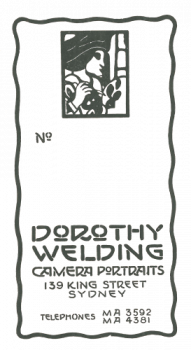
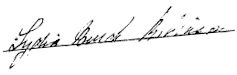
The resemblance of the two names was no accident. Dorothy Wilding’s studio in London was the height of style, fashion and excellence in photography. Wilding photographed not only high society, but also members of the Royal family. She was considered a brilliant photographer then and remains so today. Not only did O’Brien imitate Wilding’s name, her photographic style, though inferior, the style of her signature is identical to Wilding’s. O’Brien also adopted the same logo on the reverse of the photographs, moderately adapting its style and changing only the address and the “i” in Wilding to an “e”.


Wilding and Welding Portraits

Portraits by Wilding (left) and Welding (right).

The difference between the two portraits and photographic styles is demonstrated by the overall depth and clarity of the sitter’s facial features in the Wilding photograph and the accentuation of the cheeks. The shadowing of the sitter’s face is subtle and does not obscure or detract from any feature. The sitter’s face is the focus of the photograph. Welding on the other hand has softened the whole portrait flattening any level of detail. The shadowing over the sitter’s left side of her face overwhelms the portrait. With no point of focus the portrait is dull and unremarkable.


WildingWelding Logos

The respective logos from the back of photographs by each studio.


Wildly confusing

In an oral-history interview, Perth photographer Susan Watkins, a student and later a valued employee of Wilding, tells about the confusion of Australians who visited Dorothy Wilding’s London studio and believed the two photographers were connected:

“People coming into the studio have often said to me, “Oh yes, my cousin was photographed by Dorothy Wilding in the Eastern States.” And I said, “No that is not Dorothy Wilding, that’s Dorothy Welding and there’s no connection whatsoever.” [37]

Dorothy Wilding was well aware of the Dorothy Welding Studio, and though she never challenged O’Brien on her blatant infringement of copyright, she was deeply concerned over its existence. Watkins also relates in interview what her former teacher and employer thought about Welding:

“Oh well, when Dorothy Wilding knew that I was returning to Australia she said she would be very anxious to hear anything I could tell her about Dorothy Welding. She was so upset to hear that her signature had been copied, except for the dot on the e. It had caused a lot of confusion. At this time many Australians who came over to be presented at court (which was the thing to do in the thirties and forties) thought that Dorothy Welding’s studio was some branch of Dorothy Wilding in London. The idea appalled Miss Wilding because Dorothy Welding’s reputation was not a very attractive one. She was often involved in all sorts of law cases I believe. The story I was told…was that she used to come down to meet the overseas ships and get a list of the passengers and interview the VIPs and offer them free sittings, which was not really quite the thing to do. They’d come into the studio and have photographs taken and sign something which they thought was receipt for the proofs, to find that they had undertaken to order something that they didn’t expect to. I was told that she herself didn’t take the photographs, that she had several people working for her. Whether that was true or not I don’t know, but I know her reputation was not very good and Miss Wilding was terribly upset that this confusion should have arisen.” [38]


Courtroom dramas

Although Watkins’s assertion that O’Brien engaged in fraudulent business tactics was based on hearsay (“the story I was told”), there was a good degree of truth to her statement. The first indication was in October 1933 when O’Brien sued a client for money owed. [39] She claimed that the 2KY radio star and singer, Barbara Wentworth[40], had ordered prints from proofs produced after a complimentary sitting. Wentworth denied she had made any order whatsoever, as she did not like the photographs. The judge found in favour of O’Brien. But the judge’s decision was likely swayed by the fact that upwards of 880 Welding portraits had been published on the social pages of Sydney newspapers and high-profile journals[41], and that to date there was no legal complaint by any other customer on record.

Press reports of the lawsuit appear not to have had unfavourable repercussions on the studio’s popularity.[42]  The influential Australian quarterly journal, The Home, continued its semi-regular feature of Welding photographs, which began on 1 August 1932 and ran until 2 October 1934. It was called alternatively “Dorothy Welding Studies” and “Dorothy Welding Presents” and featured portraits of the notable social stars of the month.

The next milestone for O’Brien was to secure ownership of the studio in her name, which happened on 20 January 1934.[43] But with that debt finally paid and the studio doing well, it is surprising that O’Brien again pulled the same stunt as she had on Barbara Wentworth. In April 1935, Welding sued three women for failure to pay their account. [44] At the hearing in the Small Claims Court, magistrate Mr Stevenson S.M. found in favour of O’Brien in the first case, in the second he found for the defendant and the third was settled out of court with the customer paying for the photographs.

The studio must have maintained its successful status quo despite any adverse publicity from the hearing, as O’Brien applied for a 60-day visa, which she received on 27 March 1936.[45] Travelling in a first class cabin, she left Australia on 1 April 1936 and visited America, England and Canada, and returned home on 13 July 1936. O’Brien had also travelled under her professional name, Dorothy Welding, and gave her occupation as both artist and photographer. But there is no indication for the purpose of her trip, whether it was for business, pleasure or a combination of both. While abroad, her studio continued to do business, which indicates that O’Brien had another photographer working for her.

O’Brien was again in court in 1937, but in a twist of fate it was she who was being sued—and not by customers, but by her landlord. [46] Although O’Brien gave her legal address as being in Darlinghurst, for some reason she had rented a flat in the newest luxury development in Sydney: Dorchester House at 149 Macquarie Street. The building was completed in 1936 while she was overseas and it appears that she moved in sometime in October-November that same year. O’Brien’s tenancy in this building became public knowledge when Mrs Frances Berry, the building’s owner, sued O’Brien for, according to one press report, having relinquished the flat in a filthy state. She denied the accusation but the judge found in favour of Berry requiring O’Brien to pay a fine of £27.[47]


World War II

In 1938 and ’39 the Dorothy Welding Studio had a total of 133 portraits published across Sydney newspapers, but throughout the 1940s only 288 were published. It is important to add that other high-profile studios such as Dayne, Monte Luke and Falk, who had shared the social pages with Dorothy Welding, experienced a similar downturn. With the start of World War II in 1939 there was a decline in reporting social gossip and the focus shifted to wartime activities such as fundraising. Similarly photographic studios directed their lens at taking photographs of loved ones as they headed off to war. This was something O’Brien capitalised on.


Nov 23 1939 SMH

An advertisement from The Sydney Morning Herald, 23 November 1939.


Marriage

On 29 March 1943, Gladys Jacqueline O’Brien married Douglas Gordon Merchant at St Johns Church in Darlinghurst.[48] Merchant, who was born in the Victorian town of Maryborough in 1905, had been married before. In 1929 he had married Doris Evelyn Winter,[49] who died from a stroke in May 1942. A little over two months later he enlisted in the Royal Australia Navy Volunteer Regiment (RANVR) and became proficient in bomb disposal and as a diver in the deployment of mines.[50] Merchant was a Lieutenant at the time of his wedding to O’Brien, and in early 1944 was assigned to Special Branch and sent overseas. After he was discharged on 27 September 1944, he and Gladys lived in her Darlinghurst flat and he remade himself into a successful real estate agent[51] based nearby.


Illness and death

In March 1953, the couple travelled first class to London for a holiday.[52] They planned to stay at the high-end Rembrandt Hotel on Cromwell Road, situated between Kensington and Knightsbridge and opposite the Victoria and Albert Museum. However, misfortune struck when O’Brien suffered a brain haemorrhage[53] on board the ship. The Merchants abandoned their plan to stay at the Rembrandt and instead took up residence at 63 Wimpole Street, behind the University College Hospital where O’Brien may have undergone her treatment and rehabilitation. Around four months later, her body half paralysed and her ability to speak severely compromised, she was well enough to travel and the couple arrived home in Sydney on the RMS Orontes on 22 August 1953.[54]

On 9 February 1954, at approximately 5.30 am, Gladys Jacqueline Merchant was found dead on the street outside the apartment block where she and her husband lived. [55] It appeared she had fallen from a window of their ninth-floor apartment. Every bone in her body was broken.

Her death attracted newspaper headlines of a sensational nature including “Rich Woman in DEATH DROP: 150ft fall from luxury flat”.[56] Newspaper reports also revealed that Alma Collie, an employee of the Dorothy Welding Studio, was suing O’Brien for unpaid wages and leave entitlements totalling £114/0/7.[57] The legal proceedings ceased upon O’Brien’s death.

The inquest into her death opened on 26 March 1954[58] and the outcome was inconclusive. There was no evidence to fully support either an accidental death or suicide. The judge declared the former as most probable as it had been recorded that Gladys had sat at the window, which had a 6-inch (15cm) window sill, on previous occasions without incident.

Gladys Jacqueline Merchant was buried at the Church of England Cemetery in Botany on 19 February 1954.[59] The Dorothy Welding Studio was put out to Tender in November 1954.[60] It was advertised as a going concern, and continued to be listed in the Sydney telephone directory until 1956.[61]


An enigma to the end

Despite the popularity of the Dorothy Welding Studio, and that her legal actions against her clients appeared in the press, O’Brien was a very private person. She didn’t otherwise appear in the press or advertise her personal life through the social pages. She made no public announcements, including that of her marriage, and there is little indication of her social affiliations despite her sister Rene’s social connections. Moreover, O’Brien’s role in her own studio is not clear other than she owned and successfully managed the business. Whether she was the photographer or had another active role in the production of her studio’s work is a mystery. The lack of information about her leads one to suppose that O’Brien deliberately camouflaged her life to maintain the charade of an association with Dorothy Wilding.


Endnotes:

[1] Birth Certificate. Eveline Jacqueline O’Brien. No 25930/1894, Births in the District of Armadale, in the Colony of Victoria.

[2] Death Certificate. John Horace O’Brien. No 8105/1894, Deaths in the District of Armadale, in the Colony of Victoria.

[3] Marriage Certificate. Louisa McEwan and John Horace O’Brien. Registration No 180003035, 1880, Office of the Registrar of Marriages, Auckland, New Zealand.

[4] Death Certificate. John Horace O’Brien, op.cit.

[5] Birth Certificate. Mary Ann McKeun. No 10126/1856, Births in the Central District of Sandhurst in the Colony of Victoria. To date Louise’s birth certificate has not been located. However, she is listed as the first child born and 2 years old on her sister’s, Mary Ann, birth certificate.

[6] ‘Births’, New Zealand Herald, 16 December 1880, pg 4.

[7] ‘Births’, New Zealand Herald, 3 February 1883, pg 4.

[8] No indication of why they travelled to New Zealand or their reason for returning to Australia has been found to date.

[9] Birth Certificate. Clairette Kate O’Brien. No 1157/1885. Births in the District of Melbourne in the Colony of Victoria

[10] Birth Certificate. Louie Irene O’Brien. No 13246/1888. Births in the District of East Melbourne in the Colony

[11] Birth Certificate. Eveline Ida O’Brien. No 23856/1890, Births in the District of Hawthorn in the Colony of Victoria.

[12] Birth Certificate. Ruby Constance. No 27689/1892, Births in the District of St Kilda in the Colony of Victoria.

[13] Examples include: NAA A13151 /8138/1890/9177115. Application for registration of provisional patent by John Horace O’Brien and Benjamin Cockshutt Fryer titled – Improvements in window and verandah shades; NAA A13115/8139/1890/9177116. Application for registration of provisional patent by John Horace O’Brien and Benjamin Cockshutt Fryer titled – An improved machine for cutting mitres in mouldings for doors and framing; NAA A13151/1841/1890/9177117. Application for registration of provisional patent by John Horace O’Brien and Benjamin Cockshutt Fryer titled – Improvements in lock couplings; NAA A13150/9108/1891/ 7568615. Application for registration of patent by John Horace O’Brien titled – Improvements in advertising match stands; NAA 13150 A20060/1892/ 7578248. Application for registration of patent by John Horace O’Brien and Lewis Henry Nelson titled – An improved lock-nut and bolt; NAA A1315/10258/1893/ 9177862. Application for registration of provisional patent by John Horace O’Brien and Benjamin Cockshutt Fryer titled – An improved appliance for testing the proportion of cream in milk.

[14] NAA A12572/2595/1894/7666296. Application for Letters Patent by John Horace O’Brien titled – An improvement in clothes washing boards and machines; NAA A13128/A3397/1895/ 9014893. Specification for registration of patent by John Horace O’Brien titled – An improvement in clothes washing boards and machines – Registered as Patent 2642.

[15] NAA A13127/2595/1894/764668. Specifications for registration of patent by John Horace O’Brien [to Louisa O’Brien – widow – in 1894 – transferred in 1894 to The Magic Washer Company Limited] titled – An improvement in clothes washing boards and machines – Patent not registered

[16] Marriage Certificate. Louisa McEwan and Frederick Christopher O’Brien. No 5603/1895,  Marriages in the District of [Prahran], in the Colony of Victoria. To date there appears to be no obvious familial link between John Horace O’Brien and Frederick Christopher O’Brien.

[17] Death Certificate. Frederick Christopher O’Brien. No 493/1902, Deaths in the District of Beechworth in the State of Victoria.

[18] PROV, VPRS 28/P0000, 83/091 Frederick C OBrien: Grant of Probate; PROV VPRS 28/P0002, 83/091 Frederick C Obrien: Grant of Probate.

[19] “Alphabetical”, Sands Directory, 1913 pg 1978

[20] The Barony of Inchiquin was gazetted in 1845 and is in County Clare and the Castle Inchiquin, now in ruins. The castle, which is an ancestral home for O’Briens, likely provided the inspiration for the name of their home.  However, no confirmation of any direct link between this family and the O’Briens of 1845. Clare Library, Ireland

[21] ‘Advertising’, The Age, 4 January 1919, pg 2. An advert for the sale of the property further describes it as having a tennis court and a croquet lawn as well as three bathrooms.

[22] PROV, VPRS 24/P0000, 1922/941, Louisa O’Brien: Inquest

[23] Ibid, pg 5

[24] Marriage Certificate. Reginald Horace O’Brien and Ada Brazier. 1882/1905, Marriages in the District of Bourke in the State of Victoria; Marriage Certificate. Horace Samuel Kent and Alice Grace O’Brien. 311/1909, Marriages in the District of Beechworth in the State of Victoria; Marriage Certificate. Stanley Alan Bailey and Louie Irene O’Brien. 6447/1913, Marriages in the District of [Balwyn] in the State of [Victoria]; Marriage Certificate. Wilfred Madden and Daisy Evelyn Ida O’Brien. 10193/1915, Marriage in the District of South Yarra (Grammar School) in the State of Victoria;

[25] Louisa O’Brien died intestate and documentation of the division of her estate is yet to be located.

[26] Australian Electoral Commission. [Electoral roll]. Commonwealth, Fawkner State, Prahran, Subdivision of Prahran 1924, No 7068, pg 119. Ancestry.com. Australia, Electoral Rolls, 1903-1980 [database on-line]. Lehi, UT, USA: Ancestry.com Operations, Inc., 2010. Accessed 25 October 2022.

[27] Australian Electoral Commission. [Electoral roll]. Commonwealth, Fawkner State, Albert Park, Subdivision of Queen’s 1924, No 1129, pg 20. Ancestry.com. Australia, Electoral Rolls, 1903-1980 [database on-line]. Lehi, UT, USA: Ancestry.com Operations, Inc., 2010. Accessed 25 October 2022.

[28] Australian Electoral Commission. [Electoral roll]. Commonwealth, East Sydney, State, Woollahra, Subdivision of Darlinghurst 1930, No 6619, pg 111. Ancestry.com. Australia, Electoral Rolls, 1903-1980 [database on-line]. Lehi, UT, USA: Ancestry.com Operations, Inc., 2010. Accessed 14 September 2022.

[29] “Personal”, The Sydney Morning Herald, 11 January 1922, pg 10.

[30] “Argentine Consular Reception”, The Sydney Morning Herald, 26 May 1922, pg 10.

[31] “Women’s World”, The Sydney Mail, 25 November 1931, pg 20.

[32] Sands’ Sydney, Suburban and Country Directory, 1920. Johns Sands Ltd., Printers, Sydney, pg 80; “Business Changes”, Dun’s Gazette for New South Wales, 10 December 1928, pg 488.

[33] Sands’ New South Wales Directory, 1930. Johns Sands Ltd., Printers, Sydney, pg 69

[34] “Positions Vacant”, The Sydney Morning Herald, 2 May 1931, pg 22

[35] “Shipping. Projected Departures”, The Sydney Morning Herald, 21 March 1931, pg 17; “Shipping. Departures-March 21”, The Sydney Morning Herald, 23 March 1931, pg 11;  Shipping Record. 7 May 1931, Arrival of s.s. Balranald at the Port of London. Ancestry.com. UK and Ireland, Incoming Passenger Lists, 1878-1960 [database on-line]. Lehi, UT, USA: Ancestry.com Operations Inc, 2008. Accessed 29 October 2022

[36] “Winding Up of Public Companies”, Dun’s Gazette, 23 Hanuary 1933, pg 55.

[37] Transcript of an interview with Susan (Edith) Watkins 1912-2006. Photography from 1935, pg 59. Criena Fitzgerald, State Library of Western Australia, Oral History Collection. 1995. pg59

[38] Interview by Criena Fitzgerald, Edith Beryl Watkins (now Hughes), page 58 of transcript, State Library of Western Australia, J.S. Battye Library of West Australian History, 1995.

[39] “Photo Debt : Verdict Against Radio Artist”, The Sun (Syd), 26 October 1933, pg 31.

[40] April 1 1933 The Labor Daily pg 6, Today’s Broadcast, accessed 11.09am, 12 November 2022.

[41] A count of her work available on TROVE which was published in newspapers and magazines indicates at least 880 portraits were published. This was predominantly in The Sun and in high-profile journals such as The Bulletin and The Home.

[42] A count of the Dorothy Welding portraits published in the press to approximately four months between Oct 1933 and February 1934 is upwards of 500.

[43] “Satisfaction of Registered Securities”, Dun’s Gazette for New South Wales, 19 February 1934, p.163

[44] “Claims for Photos: Society Women in Court”, Truth, 21 April 1935, pg 21

[45] List of Manifest of Alien Passengers for the United States Immigration Officer at Port of Arrival, Los Angeles, California April 10 1936.

[46] “Dorothy Welding’s Flat : Landlord Gets £27 Damages”, Truth, 5 December 1937, pg 21

[47] According to the Reserve Bank of Australia’s Inflation Calculator, the amount would be $2,629.29 at the end of 2021.

[48] Marriage Certificate. Douglas Gordon Merchant and Gladys Jacqueline O’Brien. No. 7386/1943. Marriages [in the district of Darlinghurst, in the State of New South Wales]

[49] Death Certificate.Doris Evelyn Merchant. No 4789/1942. Deaths in the District of Melbourne in Victoria.

[50] NAA A6769, Merchant D G.

[51] “Business for Sale or Wanted. Doug Merchant”. The Sydney Morning Herald, 23 March 1948, pg 9.

[52] The Merchants arrived in London on 24 March 1953. Names and Descriptions of British Passengers Arrived at the Port of Tilbury, London, R.M.S. Orontes. Ancestry.com. UK and Ireland, Incoming Passenger Lists, 1878-1960 [database on-line]. Lehi, UT, USA: Ancestry.com Operations Inc, 2008.

[53] “Rich Woman in Death Drop, 150ft fall from luxury flat”, The Sun (Syd), 9 February 1954, pg 7

[54] The Merchants left London on 17 July 1953. “Names and Descriptions of British Passengers Embarked at the Port of London”, R.M.S. Orontes, 17 July 1953 for Australia. First Class Passengers, Lt. D.G. Merchant and Mrs G J Merchant, Ticket No. 10270. Ancestry.com. UK and Ireland, Outward Passenger Lists, 1890-1960 [database on-line], 2012; They arrived in Sydney on 22 August 1953. “Shipping, Sydney Arrivals”, Daily Commerical News and Shipping List, 24 August 1953, pg 4.

[55] “Rich Woman in Death Drop, 150ft fall from luxury flat”, The Sun (Syd), 9 February 1954, pg 7

[56] Ibid.

[57] Reserve Bank of Australia (RBA). Based on calendar year rates £114/0/7 would, at the end of 2021, be equal to $4,190.13. As per RBA Inflation Calculator accessed 27 December 2022.

[58] Museums of History New South Wales – State Archives Collection: Inquest Cards Index; NRS-345[13/8281] Merchant Gladys Jacqueline, File No 760, 26-03-1954. The original inquest papers no longer exist; “In the Courts, Coroner’s Doubt on Death Fall”, Daily Telegraph, 22 April 1954, pg28; “Finding on Death of Dorothy Welding”, Sydney Morning Herald, 22 April 1954, pg 7

[59] Death Certificate. Gladys Jacqueline Merchant. 241/1954. Deaths in the District of Sydney in the State of New South Wales.

[60] “Tenders, Photography Business For Sale Tenders are Invited”, Sydney Morning Herald, 06 Nov 1954, pg 35

[61] “Photographers, Portrait” Sydney Classified Telephone Directory, 1956, pg 374.

Album

WATSON, CAROLINE

WATSON, CAROLINE (1887-1978)

CAROLINE WATSON was a photographer and studio owner in Belgrave, Vic, between the years of 1924 and 1936.

Name:

WATSON, CAROLINE (1887-1978)

Full Birth Name:

Caroline Nancy Austin

Married Name:

Mrs Frank Alfred Watson (1912-1963)

Profession:

Photographer

Professional Years:

1924 to 1936

Where Practised:

Watson’s, Artist Photographer, Belgrave, VIC (1924-1934); Maroubra, NSW (1935-1936)
https://photoria.com.au/wp-content/uploads/2021/12/March-15-1924-Fern-Tree-Gully-News.png
15 March 1924, The Ferntree Gully News, pg 2. TROVE

Album

WATKINS, SUSAN

WATKINS, SUSAN (1912-2006)

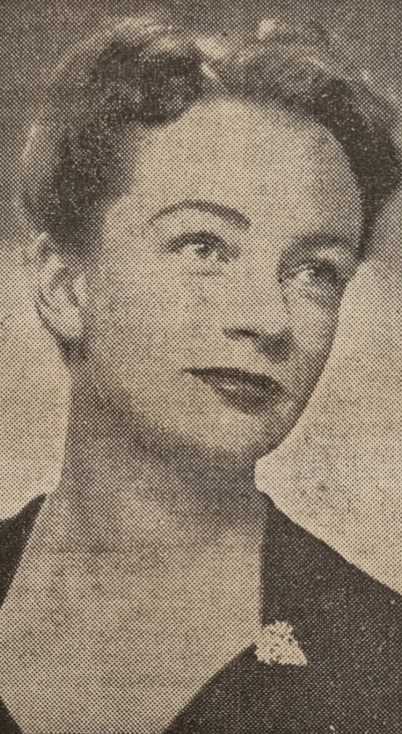
SUSAN WATKINS was a high profile photographer with her own studio on Perth’s St George’s Terrace. She worked between 1935 and 1978.

Name:

WATKINS, SUSAN (1912-2006)

Full Birth Name:

Edith Beryl Watkins

Married Name:

Mrs Gerald Hughes (1946-2006)

Profession:

Photographer and Proprietor

Professional Years:

1930 to 1978

Related Portfolios:

Notes:

Where Practised:

Dorothy Wilding, London (1930-1934); Susan Watkins, 188 St George's Terrace, Perth, WA (1935-1958); Susan Watkins, 18 Cliff Way Claremont, WA (1958-1978)
https://photoria.com.au/wp-content/uploads/2023/01/Sept-14-1935-Daily-News-WATKINS.png
14 September 1935, Daily News (Perth, WA), pg 12. TROVE, NLA

Article

Susan Watkins – Essence of Character

by Lee Kinsella


Susan Watkins was born Edith Beryl Watkins on 12 June 1912 in Western Australia. Known as Beryl as a child, she was the youngest of four children born to Arthur Octavius Watkins (1867–1948), a Welsh assayer and metallurgist, and English-born Edith Martin (1877 –1955). They married in Albany, Western Australia, in 1897.  Arthur worked in Coolgardie and Broken Hill and had gained some notoriety for his work collecting rock samples in Australia for the British Museum.  In 1899, he was appointed as the Assistant Assayer to the Royal Mint Perth Branch, a position he held until 1907 when he was promoted to the position of Assayer. The Watkins family left for England soon after his promotion, they returned in November 1908, to Perth, where Edith Beryl was born almost four years later.

Beryl attended Alexander High School, headed by Miss Hilferty, in Colin Street, West Perth.  She and her elder sister Hilda were at the school when it merged with Miss Goulay’s Girls’ Grammar to become St Mary’s Church of England Girls’ School.  The merger was a momentous occasion documented by a photograph of the 98 students on the first day of school on 14 September 1921.

Older brothers, Alfred and Reginald, attended Hale Anglican Boys’ School on St Georges Terrace, and Watkins was introduced to photography via brother Alfred:

He was thirteen years older than I am and he was President of the Camera Club, I think they call it. He was keen. I used to help him develop and print in the bathroom and make a frightful mess.

While Watkins completed drawing classes at school, she did not feel that she was particularly capable:

I wanted to do medicine. Well, not as early as that, but I was always interested in people. I loved the idea of being able paint and draw but I was not good enough so I think it followed on from there.
It [photography] was my way of recording. [1]  


1929 Prefects

The 1929 school prefects. Beryl is seated in the front row at the far left.
Courtesy of St Mary’s Anglican Girls’ School


Her parents maintained strong ties with the United Kingdom via regular correspondence and subscriptions to newspapers and magazines.  It was from reading such publications that Watkins became aware of the work of British photographers, including that of Dorothy Wilding, who was best known for her widely-published photographs of royalty and British dignitaries.  As had been the plan, her parents returned to Britain in 1929 after her father retired from the Mint.  The four children remained in Western Australia.

In 1929, Beryl was a school prefect, she achieved her Leaving with English, Biology and Drawing and won a Form VIa Academic Prize,[2] while her sister was engaged to be married. On her graduation, Beryl’s father proposed that the sisters return to England, for Hilda to have a final tour as a single woman. While in London, Edith wrote to three photographic studios seeking work, and was surprised, delighted, and a little in awe, to be accepted by Wilding.

Watkins remembered Wilding as a difficult and exacting teacher, but felt fortunate to have been taught by such a capable photographer.  Wilding was the first female appointed as the British Monarchy’s Official Royal Photographer in 1937 and her portraits of artists, academics, political and military leaders and other high-profile individuals ensured that her photographs were regularly featured in magazines and reproduced in newspapers.  Her mentor must have recognised Watkins’ capacity as she granted her special attention and, after a time, permitted her two hours a day in the studio to work on her own projects.  Watkin’s early prints were often deemed to be unsatisfactory, with Wilding tearing them to pieces.  She first assisted Wilding during the difficult sitting of Irish writer, playwright and activist, George Bernard Shaw. Photographic historian and curator, Terrance Pepper writes of the event in In Pursuit of Perfection:  The Photographs of Dorothy Wilding, the catalogue that accompanied the exhibition of Wilding’s portraits at the National Portrait Gallery, London, in 1991:

Shaw’s arrival at the studio had been unannounced and unexpected. He had gone to Bertha Hammond’s hairdressing salon, situated in the same building as the studio, and being pleased with his haircut decided to have his photograph taken. Wilding was hastily contacted at the consulting rooms of her Harley Street doctor. Her two successful portraits show Shaw twinkling as ever in rapt attention, craning forward due to his partial deafness to catch what she was saying. The portrait of Shaw holding his hands to his head became even more well known when it was cast in bronze by Kathleen Scott, Lady Kennet. The other pose is reproduced on the dust jacket of Wilding’s autobiography.[3]

In her autobiography, Wilding smoothed over the drama:

Another Irishman I photographed with joy was George Bernard Shaw, who also came into the Bond studio. [4]

My meeting with him that day allows me to state two certain facts about Bernard Shaw.  He enjoyed being photographed and he liked female attention. He most willingly struck any pose I asked and positively purred as my girl assistants fussed around him[5]

However, as one of the ‘girl assistants’, Watkins’ recollection is vastly different.  She noted that Shaw had particularly ‘ugly’ hands and did not want them to be included in his portrait.  Wilding disagreed and suggested that she could manage them through her judicious posing and use of lighting.  The discussion became heated and Wilding left in tears, leaving Watkins hovering awkwardly in the studio with Shaw.  Wilding returned and shot various poses, with and without hands.  On seeing the proofs, Shaw wrote to apologise and acknowledge his error, demurring to select two unique portraits, both with hands featured:  one with him clasping a book in profile and the other with his head resting in both hands and furtive eyes as they looked towards the camera.

Wilding, in turn, had apprenticed under artist and photographer Marian Neilson (1875 – 1965).  In Neilson’s Bond Street studio, Wilding came to learn the art of retouching negatives and absorbed Neilson’s style, which was characterised as more relaxed and modern, with scenery from contemporary life as background, rather than the standard formal Victorian photography.

Wilding consciously discarded the detail of Neilson’s backgrounds to create clean and sparse spaces in which the features of the sitters, and the contours of their clothing, created the drama.  Wilding was influenced by Art Deco aesthetics and classical lines, and this was also reflected in her Deco studio logo that featured Wilding as an artist with palette at work, with her distinct wavy hair.

DorothyWildingLogo

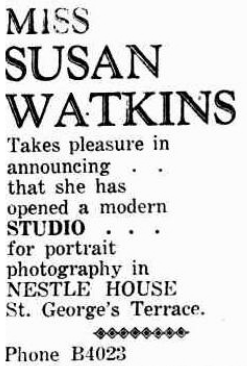
Susan Watkins Logo

Watkins benefited in many ways from being part of this legacy of generations of women photographers. Watkins’s professional logo, “Susan Watkins Camera Portraits”, reflected a more pared-back aesthetic, and she understood the need to adapt and reflect the desires of contemporary sitters.  Props and scenery were absent from her portraits, with Watkins relying on the camera and lighting to frame and capture an accurate representation of each sitter.  She was adamant that her portrait photography contained no trickery, noting that negatives and prints were corrected to ensure that a stray hair, errant fold of material or speck of dust did not disrupt the composition of the photograph and distract from the sitter.

Beryl adopted the professional name ‘Susan Watkins’ while in London, and returned to Perth with ambitions to open her own studio. She was offered the opportunity to design her photographic rooms, based on her working knowledge of Wilding’s studio, with cantilevered lights and plain backdrops on sliding screens in light, medium and dark.  At the age of 23, she opened her own photographic studio at Nestle House, 188 St Georges Terrace in Perth in 1935.  As a woman establishing her own studio in the male-dominated photographic profession during the Depression, Watkins soon demonstrated her capacity as a highly technical and capable photographer with an acute understanding of the need to sensitively manage her sitter’s expectations.  Hers was the only Perth studio offering a set price list and fee for photographic sittings at the time. In a 1995 interview, Watkins recalled her experiences working in her studio:

Well, I loved taking childrenWith women, I liked young women and old women. [laughs] The middle-aged ones I found extremely difficult. They had no idea what the years had done and I had difficulties. [laughs] Either I pleased them and their families said, “Oh, dear, that is flattering,” or I pleased the family and they said, “Oh, don’t I look an old hag [?].” So, it was very difficult.[6]

Watkins was acutely aware of the aspirational aspect of portrait photography and her need to dance the fine line between presenting a recognisable and realistic likeness of the sitter and obtaining the approval, and payment, of her client.  Her sensitive photographs and her capacity to read people and gently manage them to best effect saw demand for sittings increase.  Word-of-mouth recommendations ensured that the month’s sittings were often booked out within minutes.

As the Daily News reported on 15 November 1935:

Miss Susan Watkins, who was born in Perth and educated at St. Mary’s Church of England Girls’ School, is another of the younger generation of women who has encroached into the male’s field in her choice of profession.[7]

In addition to the perception that Watkins may have been broaching into a male profession, her arrival in Perth created some interest, and rivalry, amongst the established Perth photographic studios.  Unbeknownst to her at the time, her request list of equipment necessary to establish her studio had been circulated to other studios, and time and again she was thwarted in her request for both equipment and photographic supplies.  It was Dorothy Wilding who bought studio equipment for Watkins and sent it from London.  Later, when Australian-made Kodora paper (Gelatine chloro-bromide development paper created for the professional market) proved to be inadequate for Watkins’s enlargement prints, ‘Miss Wilding’ again sourced English-made supplies and sent them to Western Australia.  Watkins equipped her studio with a large Kodak camera, and later a Graflex Reflex.  She also acquired a Minex camera: its macro focusing ability made it particularly useful for photographing children.  She initially began using Kodak film and later imported her own Ilford film.  Watkins did not have close associations with other Western Australian photographers, although she did express an appreciation for Axel Poignant and his late photographic work.

At the peak of demand, Watkins employed 13 staff – all women – within the facility that she had designed with no thought as to the future need for this many staff.  She recalls everyone being very cramped but that there was great collegiality:

Well, there were four girls in the retouching room, three girls in the finishing room, one girl using the studio to work in where there was a spare desk if there was no sitting, a receptionist and an assistant receptionist. I don’t know how many I’ve got to – and two in the dark room, not all the time. I mean they kind of milled around, but that was the worst period.[8]

Watkins was very specific about the technical requirements of photography, but also aware of the need for creative input and artistry.  Most photographers in Western Australia used Australian panchromatic film, but Watkins used orthochromatic film, which is blue or green-sensitive and unable to capture reds.  Later she used hydrochromatic film, which is also insensitive to the red end of the spectrum and so lipstick had to be removed as it photographed black. Her film choice provided Watkins with a clear tonal separation and an ability to capture fine detail (and blue eyes!). However, this film required a lot of sensitive retouching.  She considers the difference:

Well, blue eyes on panchromatic film tend to photograph without any detail in them. I always said they had a boot button look. They do!
They lose you don’t get all the little flecks. The lighter colour eye usually has a rim around the edge of the iris, you don’t get that. It somehow lacks character, a print from a panchromatic film, especially for men. Men on orthochromatic or hydrochromatic film, you get a much richer texture. Personally, I don’t think there’s any comparison. [9]

Watkins also inherited a special, secret recipe for developer solution from Wilding. The chemical ingredients were mixed from scratch and resulted in warm, not sepia, tones.  Processing was completed on the basis of experience and close observation, rather than using commercial products and simply timing the process.

Erica Hall was Watkins’ school friend and enthusiastic supporter, encouraging her to open the studio.  She was the first receptionist and is likely to have actively encouraged their circle of friends and associates to have their portraits photographed by Watkins.  Hall’s own fresh-faced portrait is featured alongside representatives from other well-known Perth families in the social pages of “The Passing Show” on page 29 of the Western Mail, published on 4 June 1936.  Since opening the studio in 1935, during the Depression, sittings with society women, including debutantes and other young women from wealthy families, such as Miss Pat Drake-Brockman, was the mainstay of her business.[10]  Her own family was regularly mentioned in the social pages of the newspaper, and she was known to many of her sitters.  Indeed, over the years, her clients included generations of affluent Perth families.  Watkins use of strong light, and the resulting high contrast, enabled the portraits to reproduce well in newsprint, and the many ‘Susan Watkins Camera portraits’ of relaxed, confident young women enlivened the social pages.

The Western Mail, 4 June, 1936

“The Passing Show”, The Western Mail, 4 June 1936, pg 37.
All photographs on this page are from the Susan Watkins Studio.


It is likely that Watkins would not be pleased that many of her proofs are now publicly available, as she was fastidious about her work and the working proofs are not consistent with the quality of the final enlargements.  That said, they do provide useful insights as to her process.  Watkins booked a maximum of three sittings per day.  Negatives were developed, and a set of prints created.  Hours were then spent retouching negatives before the creation of another set of prints – these were the proofs that were shown to the client.  Prints were selected and the proofs returned and checked again, with any other corrections made on the negatives.  Finally, enlargements were printed and finished with judicious hand-work on each print.

As a founding professor of English and former Chancellor of The University of Western Australia, Professor Walter Murdoch is an example of the politicians, academics and social figures who sought Watkins’ services for formal portraits.  Using a dark background and her preferred overhead lighting, the head of the esteemed professor is the lightest area and the high contrast draws attention to his face.  His brows cast shadows and add weight to his eyes as they gaze intensely outwards.  With pipe in hand, the line of the pipe further directs attention to his face.  Crop marks indicate the edges of the enlargement to be printed and the judicious removal of his exposed arm results is a solid and impressive portrait.


slwa b3924861 1

Professor Walter Murdoch, 17 October 1939. 304572PD. Courtesy, SLWA

This portrait was taken in 1939, a time of great turmoil for Watkins.  Her eldest brother had died unexpectedly of appendicitis, and her parents had been captured on German-occupied Guernsey, one of the Channel Islands, in the United Kingdom.  Her father died that same year. Watkins, working under duress —managing her studio during a period of high demand and wartime restrictions of materials—was unable to quickly recover from a virus. She decided to take six months leave, during which time an experienced photographer, Mattie Hodgson, ran her studio.


Studio portrait of 385 Flight Lieutenant Charles Cuthbertson Learmonth.

Formal portraits of individuals in uniform feature during the war years, including a portrait held in the Australian War Memorial of  Flight Lieutenant Charles Cuthbertson Learmonth.  Watkins took the portrait in 1941. He died when a Beaufort Bomber crashed into the sea near Rottnest in 1944.


slwa b2393985 1

Portrait of Miss Minnie Goldstein, 1942, 220168PD, Courtesy, SLWA

In another proof taken from a sitting in 1942, we see Sister Minnie Goldstein in her military nurses’ uniform, framed in a halo of light. Minnie Goldstein is mentioned as an associate of Watkins, who attended a party at her flat in August 1935. And yet, in this portrait, Watkins has chosen to formally represent her friend in her offical capacity. Nurse Goldstein enlisted in Northam, Western Australia, on 28 August 1942, and is here captured far more sensitively than her enlistment photographs.[11]  It is likely that the portrait was taken while she was on leave in July 1942. The sharp lines of the white, starched collar combine with the soft focus of her head-dress to frame her face. The photograph demonstrates great control of focus as her eyes and military insignia are in sharp focus, while the lines of her face are softened, as she gazes forward into the middle distance. The demarcated area indicates that the enlargement will square up the portrait, presenting Goldstein, Service Number – WX32605, as a solid and reliable individual. Her contribution to the operations of the blood bank in Alexishafen, New Guinea, was documented by Official War Artist, Nora Heysen in 1944.[12]


Watkins’ photographs, taken in 1943, [attributed] of bride, Hilda Mary Hartle, demonstrate the exacting technical and presentation standards to which she worked.  Much time and effort was required to realise a quality enlargement print, which was then mounted within seven layers of specially cut paper, with care to maintain sympathetic proportions around the print.


SusanWatkinsTintedPortraitofBridefront

Portrait of the Bride, Hilda Mary Hartle, Perth, WA, c1943. Photoria Collection


In order to try and reduce the variables that could negatively impact upon a sitting, Watkins preferred the controlled environment of the studio.  When asked to document a wedding, she would invite the wedding party to her studio after the ceremony, and carefully arrange the sitters, preferring also to focus upon photographing single sitters.  The final print, as in this case, was tinted with colour on request.  Again, she advocated for the subtle use of paint and a very light touch in order to create a sensitive representation of the sitter.   In this example, Watkins takes full advantage of the soft, diaphanous material to frame the figure, and anchors the flow of the fabric against the structure of the stairs. Again, following Wilding’s example, when satisfied with the enlarged and finished print, Watkins would sign in pencil on the left beneath the print.  This is consistent with their shared understanding of photography as an art, and the unique qualities of each photographic print.

SecretlyWed

“No Photographs When Susan Watkins Weds”,
Daily News (Perth, WA), 7 January 1946, p. 6.

In 1946, Watkins married Gerald Hughes and they managed the photographic studio together. This enabled Watkins more time to spend with their young daughter. By 1958, the couple were able to move the studio to their home, at which point Watkins resumed the running of the business.  She now enjoyed the flexibility of booking up to three sittings per week, completing all of the work herself, and to her own schedule around school holidays.


LeSouef

Studio portrait of Colonel Leslie Ernest Le Souef, OBE ED MD FRCS FRACS.
P03614.001. Courtesy Australian War Memorial.

The portrait of Colonel Leslie Ernest Le Souef was taken on 16 February 1950 in Watkins’ home studio. It is a warm and lively portrait of a bemused Le Souef, gently enhanced with the aid of her brush and paint to create eyelashes to frame twinkling eyes.


Watkins’ legacy remains in the countless high-quality studio portraits that are held by hundreds of families and in various Australian public collections, including the State Library of Western Australia, the National Portrait Gallery, The Australian War Memorial and the National Library of Australia. In addition, she trained generations of women within her photographic studio — photographers, including Jill Crossley, and many technicians, developers, re-touchers and finishers who worked with her over the 23 years that she ran a commercial photographic studio.  Susan Watkins continued to work from her home studio until her retirement in 1978.


About the Author:
Lee Kinsella is a writer and visual arts curator who lives in Boorloo/Perth on the traditional lands of the Whadjuk Noongar peoples. She is currently curator of the Cruthers Collection of Women’s Art at The University of Western Australia. She has curated and managed exhibitions at Australian state and national public institutions, including the Art Gallery of Western Australia, The Australian War Memorial and The National Film and Sound Archive (formerly ScreenSound Australia). Kinsella has written catalogue essays, articles and contributed to several books on Australia art.


The Author would like to thank:
Stephanie Neille, Archivist, and Dr Jan Ring, Researcher at The Marlene Carter Heritage Centre, St Mary’s Anglican Girls’ School, and Emma Withers, Archivist, Hale School. And special thanks to Photoria for the invitation to write and for all technical support.


ENDNOTES

[1] Interview by Criena Fitzgerald, Edith Beryl Watkins (now Hughes) talks about her long career as a portrait photographer. Transcript, p. 5. State Library of Western Australia, J.S. Battye Library of West Australian History, 1995.

[2] Academic record thanks to the staff at the The Marlene Carter Heritage Centre, St Mary’s Anglican Girls’ School

[3] Terrence Pepper, In Pursuit of Perfection: The Photographs of Dorothy Wilding, 1991 (accompanying the exhibition at the National Portrait Gallery from 5 July 1991 – 29 September 1991), p. 53.

[4] Dorothy Wilding, In Pursuit of Perfection, (R.Hale: London, 1958), 68.

[5] Ibid, p. 69.

[6] Transcript, op.cit. pg. 22

[7] The Daily News, Perth, Western Australia, 15 November 1935, p. 10 (LATE CITY)

[8] Transcript, op. cit.  p. 26.

[9] Transcript, op.cit. p. 16

[10] National Library of Australia

[11] NAA: B883, WX32605. GOLDSTEIN MINNIE SUTHERLAND : Service Number – WX32605 : Date of birth – 13 Aug 1908 : Place of birth – RAVENSTHORPE WA : Place of enlistment – NORTHAM WA : Next of Kin – GOLDSTEIN MINNIE

[12] Australian War Memorial

Album

WARNER, DOROTHY

WARNER, DOROTHY (1890-1969)

DOROTHY WARNER was a photographer and studio owner in Kapunda and Adelaide, South Australia between 1910 and 1920.

Name:

WARNER, DOROTHY (1890-1969)

Full Birth Name:

Warner, Dorothy

Married Name:

Mrs Richard Douglas Spencer (1920-1969)

Profession:

Photographer

Professional Years:

1910 to 1920

Where Practised:

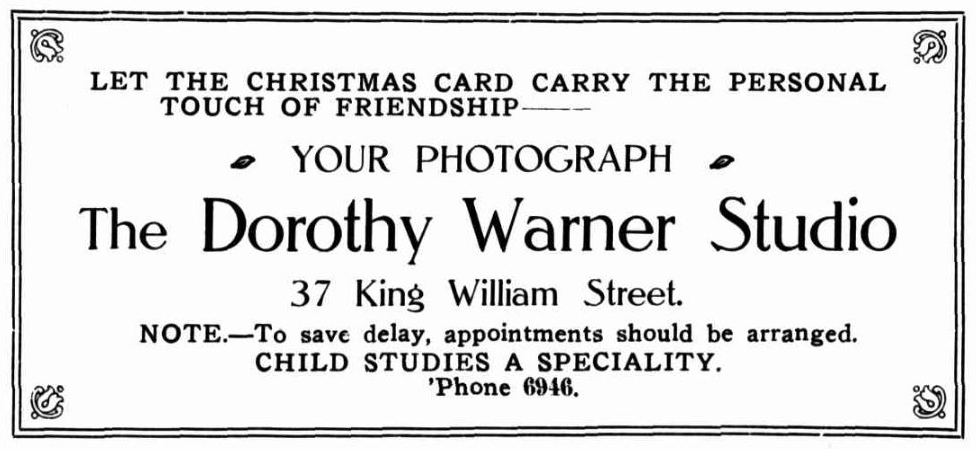
Adelaide, SA (1910-1912); Kapunda, SA (1913-1916); Dorothy Warner Studio, 37 King William St, Adelaide, SA (1917-1920)
https://photoria.com.au/wp-content/uploads/2022/01/Oct-24-1917-Critic-SA-d-warner.png
24 Oct 1917, The Critic (SA), pg 21. TROVE

Article

It’s unusual to be able to track any photographer’s path, let alone a woman’s photographic career. However, Dorothy Warner is a rare case in that her career can be tracked through the Australian press – newspapers and magazines. Presented here are some of the texts from her various appearances in the press.


SOUTH AUSTRALIA.
KAPUNDA PHOTOGRAPHIC CLUB.

(Originally published in Interstate News, Australasian Photographic Review, 21 November 1907, pg 431.)

The regular fortnightly meeting was held on 29th October. The President, Mr. M. Thomson, presided over a good attendance of members. Mr. Thomson, in his opening remarks, said he would like to refer to the success of Mr. J. Kauffmann, a member of the Club, who had had three pictures accepted by the Royal Society of London. He believed that two of the three subjects were Kapunda pictures. He also referred to the success of Miss Dorothy Warner (daughter of the Secretary of the Club) at the Women’s Exhibition in Melbourne, where she had gained two first prizes, silver medal, and two special prizes, for photographic work. Mr. Parker said, though Miss Warner was not a member of the Club, she was well known to all of them, and he moved that a minute be made that the Club congratulated her on her success. The proposition was carried unanimously.

***

KAPUNDA PHOTOGRAPHIC CLUB

      (Originally published in the Australasian photo-review, 22 October 1909, pgs 551-552)

On September 8th the Kapunda and Light Agricultural Society held its annual show, and as a photographic exhibition is a special feature in connection with this show, the members of the Kapunda Photographic Club made a special effort to keep up, and if possible, to surpass its reputation gained by former exhibitions. It only needed a glance at pictures hung upon the wall to see that the club had excelled itself this year. Altogether there were about 90 framed pictures, 85 of which represented the work of the club members, for although the club gives every facility for outside workers to compete against them, and are desirous of them doing so, few take advantage of the opportunity. It will be noticed from the awards that the indefatigable secretary of the club is once more very much to the fore, while some of the older names have dropped out, and younger ones have taken their places.
The workers were divided into two sections —Senior and Junior—but this year there was no competition in the Junior section, Mr. E. K. Jeffs taking all the prizes. This, of course, meant that there was the keener competition in the Senior division, and Mr. A. H. Kingsborough afterwards acknowledged that he has never had a more difficult lot of pictures to judge, but when his decisions were known, members were unanimous in their praise of his impartial judging. In Portraiture, Mr. T. Warner secured first prize with a carbon enlargement, showing excellent lighting and tonality. This picture also secured the position of champion of the exhibition. Mr S. A. B. Oats was placed second in this class, with a pleasing softly-lighted profile executed in sepia carbon. In Landscape or Seascape, Mr, J. E.A. Klose, the newly-elected President of the Club, secured the first award with a pleasing little green carbon of rather good quality. Mr. T. Warner was placed second.
In Hand Camera Work, Mr. J. E. A. Klose was again placed first, with Mr. Warner second. In Bromide Enlargements, Mr. C. C. Belcher was awarded first place, with Miss Dorothy Warner, and Mr. J. E. A. Klose equal for second place. There was not much competition in Post Cards, Miss Dorothy Warner being awarded first and second prizes.
In Genre, Mr. T. Warner scored first again, with an excellent study of Tyring Wheels; Mr. A. Berrett secured second place with a lucky snap of a person of pronounced Parliamentary debating tendencies, for the moment quite oblivious of the presence of the camera fiend. Mr. T. Warner secured first and second prizes for Flower Studies, and was again successful in gaining first for collection of five pictures ; his daughter, Miss Dorothy Warner, being awarded second place with a collection very little inferior.
Altogether the exhibition was a great success, the pictures being viewed by a large crowd during the afternoon.
J. E. A. KLOSE.
Acting Press Correspondent.

***

THE EDITOR’S LOCKER

(Originally published in the Australasian photo-review, 23 September 1912, pg 525)

Yet another lady professional photographer is Dorothy Warner, Kapunda, S.A.,who puts out a dainty four page price list, giving full details of the charges for prints on various papers. Amongst these are platinotype, aristotype, and autotype carbon, showing that Miss Warner’s technical knowledge must be extensive.

***

A CHAT WITH A LADY PHOTOGRAPHER.

(Interview, originally published in The Critic, 15 July 1914, pg 26)

Last week a very charming little lady—Miss Dorothy Warner, of Kapunda—called to see us, bringing with her such excellent examples of high-class portraiture that we published three as studies in our last issue.

“What caused me to become interested in photography ?” said Miss Warner. ” Well, for years my father has been enthusiastic over camera work, and often has his photographic friends to stay with him. I was soon imbued with the same ideas, and often joined in the photographic expeditions. Mr. Kauffmann, one of Australia’s leading pictorial workers, encouraged me to use a small camera won by my father at a photographic exhibition. With this camera I did some good landscape work, and in 1906 secured champion prize at a local exhibition”.

And since then ?

“Still improving in 1907, I exhibited in the Adelaide Woman’s Work Exhibition, and secured first prizes in every section for which I entered. These same pictures were then forwarded to the Melbourne Woman’s Work Exhibition, where there was keen competition”.

Were there many competing ?

“Something like three hundred and sixty; but I won first prize silver medal, two special prizes, and a diploma. Also the sum of £5 awarded me for the best picture exhibited. This encouraged me to secure a larger camera, which enabled me to take up home portraiture, and in 1910 exhibited at a local exhibition and secured first prize in portraiture section, Mr. F.A. Joyner being the judge, who, in his remarks, said the work in this section was much above the average”.

By that time you must have realised that photography was your forte?

“Yes; I decided then to make it my profession, and I entered one of the leading city firms for practical experience, and the longer I worked at it the more fascinating I found the work ; and on returning to my home in Kapunda some two years later I started a private studio of my own”.

As a photographer?

“Yes, my speciality being ladies and children’s portraits”.

Do you find it easy?

“Well, the lot of professional photographers would be less difficult if people suffered less from self-consciousness”, replied Miss Warner. “We have to make them forget they are before a camera: and the only way to do it is to act and talk in a matter-of-fact way with them. I have spent as much as two hours taking the photograph of one child, as often they are very shy, and that has to be overcome”.

Do you object to relations and friends being present as well as the subject?

“Yes”, said Miss Warner very emphatically, “I do ! their company is seldom helpful. I give great attention to every sitter to make it distinctive in regard to style and printing”.

Which is your favorite[sic] process?

“Carbon, it being most permanent and artistic. In no other process can you get the wonderful rendering of draperies and half tones. Special attention to the trimming and selection of suitable mounts is essential to make each one a picture as well as a faithful portrait”.

Do you find the public ready to pay for good work?

“They are undoubtedly looking for and expecting something more artistic in portraiture, be it in style of printing, size, or design of mounts, and they are prepared to pay well for anything that pleases them. At least, that has been my experience ; and it is satisfactory to know one’s clients are pleased. It is quite surprising, too, the number of city patrons that have visited my Kapunda studio for sitting : and I am always kept busy, as the work, finishing, &c., has my personal supervision in each department”.

“Yes”, concluded Miss Warner; “the Adelaide public will have the opportunity of seeing my work at the Adelaide Camera Club Exhibition, in Society of Arts Rooms, North-terrace, on July 20, 21, and 22, from 1 to and 8 to 10, where I shall have my collection on view”.

***

DOROTHY WARNER
South Australia’s First Woman Photographer

By Muriel E. Farr

(Originally published in The Lone Hand, 1 January 1919, pg 16.)

IT is just twelve months since Miss Warner opened her studio in King William Street, Adelaide, and in that time her venture has passed triumphantly from experimental stages to the realm of assured success, and has banished any doubts she may have entertained as to Adelaide’s need for a woman photographer.

Long before she had any thoughts of taking it up seriously, she served an unconscious apprenticeship to her profession under Mr. Kauffmann, Adelaide’s most noted amateur photographer, and her own father, who was no less enthusiastic. The long tramps in search of suitable “subjects,” and the longer hours spent in the technicalities of camera craft, fostered and encouraged her instinctive love for the work and gave her a foundation of practical knowledge that has since proved invaluable. Then came the Women’s Work Exhibition and her success there (she won all prizes for photography, including the Championship) suggested that her hobby might easily be developed into something more useful. An article on Alice Hughes or Lallie Charles, which she chanced upon about the same time, added fuel to the fire of her resolve, and she determined to adopt photography as a profession. For two years she worked in a leading Adelaide studio, and then returned to her own home at Kapunda, about fifty miles north of Adelaide, and established herself as a photographer. For three years she continued there in a small way, but illness intervened to write a temporary finis to her activities, and she almost decided to abandon the whole idea. However, when an opening presented itself in Adelaide she decided to take advantage of it, and it is a decision she has never had cause to regret.

From the outset she has managed the whole business herself, personally supervising every branch of the work, doing all her own operating, and even —  despite a complete lack of business experience — shouldering the whole of the business responsibility. In this connection she is a strong believer in American methods, and when illness laid her low in the winter, just as she was beginning to work up a connection, she devoted her time to reading everything she could find concerning business management and development. She returned to work just as a huge children’s fancy dress ball was given for one of the patriotic funds, and promptly despatched invitations to some of the small people to come and be photographed. In a few days her showcase was full of miniature cowboys and pierrots, be-crinolined early Victorians and demure heroines of nursery rhyme. A short time later, when the girls from the Red Cross tea rooms staged a brilliantly successful amateur revue, Miss Warner did the same thing, and now business is booming so satisfactorily that she and her three assistants are constantly busy fitting work and appointments in.

In the beginning children bulked largest among her sitters, for she has a happy knack of taking them when they have no suspicion that anything more is afoot than a game in a large, cheerful room with particularly nice toys and a particularly nice girl; indeed, if she has her way, children are only told that they are going to play with some new toys, and photographs and photography are not mentioned at all. Now, however, she numbers amongst her clients just as many grown-ups as children, and she has proved that she can take men and women with equal success. The head-rest she never uses. Her great aim is to get natural pictures, and that, she contends, cannot be done if a head-rest is allowed. It is no small tribute to her that a well-known man who was sceptical concerning women photographers in general, and only suffered himself to be led to her rooms under protest, subsequently admitted her portrait of him the best he had had and followed up his original order by getting one of the colored[sic] miniatures in which Miss Warner specialises.

***


UP-TO-DATE PORTRAITURE

(Originally published in the Mail (Adelaide, SA), 6 March 1920, pg 13.)

Photography has long since come into its own as one of the fine arts, and we have in Adelaide an enterprising portraitist the person of Miss Dorothy Warner, who is the fortunate possessor of the true artistic sense, combined with, first-class business methods and untiring energy. Miss Warner believes in making the ordeal of having one’s photograph taken less of a nerve-racking experience than many, and with this object in view she has had her studio and reception room made even more attractive than formerly. While you are waiting for the call to the Studio above you have much within your range of vision to assist in the production of ‘that pleasant expression’ with which, you hope to gratify your friends and annoy your enemies. Handsome wood panelling, mounted by shelves, lines the walls, and grouped among excellent samples of Miss Warner’s art are many vases of beautiful flowers, all grown by the artist in her own garden. Miss Warner’s clientele has increased so marvellously that she has doubled her staff of assistants, and between them they have effected hundreds of successful and characteristic portraits of well-known citizens. A speciality is made of child studies, and Miss Warner succeeds here because she so distracts the attention of her sitters that they are blissfully ignorant as to the exact moment when the camera clicks. In one week alone she took the portraits of twenty-two children all under three years of age, and each picture was a speaking likeness. All her mounts and materials are Australian, proving that it is by no means necessary to apply to America for aid in this direction. Keiv styles in photography are originated constantly, and a feature of her work is the number of artistically coloured prints, both in oils and water colours. Miss Warner is very strong on the natural pose of her clients: consequently there is nothing forced or strained in her results. She is a living example of a South Australian woman who has more than made good.

***

Album

WALL, ISABELLA

ISABELLA WALL (1868-1953)

ISABELLA WALL was the proprietor of a photographic postcard business in St Kilda, Melbourne between 1936 and 1947.

Name:
ISABELLA WALL (1868-1953)
Full Birth Name:
Isabella Elizabeth White

Married Name:

Mrs George Weston Wall (1891-1936)
Notes:
Profession:
Proprietor
Professional Years:
1937 to 1946
Where Practised:
Postcard Experts, 145 Chapel St, St Kilda, VIC