Miss Elliott is the Operator
by Sally Jackson
In February 1880, a new photographer had seemingly sprung out of nowhere and opened a studio called Elliott near the top end of Melbourne’s CBD.[1] Specifically aimed at women the studio was located at 139 Bourke Street, directly opposite the Cole’s Book Arcade, something that was duly noted in a line advertisement in one of Melbourne’s daily papers.[2]
The Coles Arcade was itself a newly established local landmark, not only as an attraction for shoppers and tourists but also as a hub of political and social debate among the intelligentsia. Given its proximity to the Arcade, Elliott was quickly noticed and received high praise from Melbourne society. Within a few weeks of opening, “Phota”, a columnist for the Melbourne newspaper The Herald, wrote that Elliott’s work was of an exceptionally high standard and exhibited great attention to detail, which resulted in images of extraordinary clarity. “Phota” also made it quite clear that “Miss Elliott is the operator” and the person in charge of the studio.[3]
Miss Elliot was Florence Elizabeth Elliott and she was just 22 years old when she opened the Bourke Street studio. As far as “Phota” could discern, Miss Elliott was the only woman, even the first woman, to hold such a position in Melbourne.[4] According to “Phota”, Elliott’s influence and discrimination was recognised at each step of the process required to produce a finished photograph[5], and her reputation would continue to grow due to specialising in the particular needs of ladies and children.
Family background
Florence Elizabeth Elliott, known as Flora,[6] was born in Launceston in 1857. She was the first of eight children born to Catherine Hogg and George Boulton Brown Elliott, who had met and married in Hobart in 1856. Catherine and George were identified as farmers on their wedding certificate, but hadn’t remained so and within 18 months of their wedding day had ventured into mining in the Emu Bay area, approximately 140 kilometres northwest of Launceston. George became a speculator, investor, broker and an inventor. When he encountered trouble with his shipping needs he commissioned a ketch to be built, which he and Catherine named “The Florence Elliott”.[7]

1 March 1879, The Argus, pg 2. TROVE
Miss Elliott’s Photographic Gallery
In the 1870s the family established a Melbourne base and purchased a home at 20 King Street in West Melbourne. It was a 10-room brick home called Clydeside House[8], which overlooked the Flagstaff Gardens. This was where Florence began a photographic business known as Miss Elliott’s Photographic Gallery.
In 1916 George Elliott, Florence’s father, was the subject of a newspaper article about old colonists in which he made many claims, amongst them that he was the first to use artificial light to take photographs.[9] That George Elliott may or may not have practiced photography, whether professionally, or as an amateur or hobbyist, has not been substantiated. But given that Florence established her first studio at Clydeside House in March 1879, and given that her father was something of an inventor, then there was likely some truth to George Elliott’s claim. This is because of the strong possibility that it was in his daughter’s studio that he would have experimented with taking photographs by artificial light.
More importantly, however, it is with Miss Elliott’s Photographic Gallery that Florence began her rise to become one of Melbourne’s finest photographers. She may have started this studio as a hobby without any intention of turning it into a fully-fledged business. Yet Miss Elliott’s Photographic Gallery must have enjoyed some degree of success for, in the following year, Florence moved into a professional studio in one of the city’s best locales where other professional photographic studios had thrived.
Training and apprenticeship
It is not known where and when or even if Florence took formal training and apprenticeship in photography. “Phota” reported that she had trained in and practised photography for four or five years, but that period obviously included her time at Miss Elliott’s Photographic Gallery prior to opening Elliott. At her first studio Florence offered—and presumably delivered—coloured enlargements, mounting and framing. Such expertise would have required a teacher and years of practice before going it alone. Given that Kate Elliott, Florence’s sister, was a student at the National Art Gallery[10] raises the possibility that Florence had also gained this expertise in the same way. House. Overall, however, there is no evidence at this stage to confirm whether Florence had attended art school or had worked for a photographer while the family was in Tasmania or when the family moved to Melbourne.
Elliott
As Melbourne was flush with photographic premises[11] Florence’s move to Bourke Street indicates her confidence in her expanding skills, as well as the public’s faith in those skills. Her prices were competitive with other studios, but that would not have been enough to warrant such a move if her work was not up to an acceptable standard. Her Bourke Street competitors included two of the great studios of the 1800s—Stewart & Co and Johnstone & O’Shannessy. The latter studio not only had a woman working in a high-level position as co-owner, colourist and photographer she was identified in the studio name: Emily Florence Kate O’Shannessy.
The change of name from the lengthy Miss Elliott’s Photographic Gallery to the more effectively robust and non-gender specific Elliott is indicative of Florence’s growing sophistication and business acumen. She also had the good sense to retain a focus on the photography of children and ladies by promoting herself as Miss F.E. Elliott, the attending photographer. This was a distinctive feature certainly not lost on “Phota”, who wrote:
I should think that many ladies would prefer to be under the hands of a lady operator – there being so many mysteries of becomingness in dress and fixings of position and fal-lals[12], which the lordly and impatient masculine temperament cannot be expected to sympathise or have patience with… [13]
Florence’s Bourke Street studio, which was basically a one-room brick building, had been a base from which other photographers had operated, notably Aquila J. Davis, T. Chuck and, just prior to her taking over the lease, N.J. Caire. According to rate notices, it appears T. Chuck had paid rates up until 1881, after which he had sub-let the studio to Florence, who paid her own rates when she took on the lease.[14]
Her studio’s locality was one of the busiest in the city. It was close to the Eastern Markets and the Eastern Arcade[15], and, as previously mentioned, opposite the Cole’s Book Arcade. The 139 Bourke Street property had been a photographic studio since the mid 1870s, and now Elliott was the only photographic studio on the block, that is between Russell Street and Exhibition Street.
Florence’s gender, although considered an asset for working with children, could have been an anathema for adult patrons, particularly men. But the fact that she successfully operated Elliott for three years strongly suggests that her photographic skills far outweighed any form of gender bias. This was further strengthened by her next professional step.

View of Georges & Georges on Collins Street looking east towards the Melbourne Town Hall. Photoria Collection
The Federal Studio
Melbourne was rolling in wealth in the early 1880s as people rich from the Victorian gold fields or early pastoral holdings continued to prosper and invested in local industries and land development within the city. It was around this time that the city was popularly dubbed “Marvellous Melbourne”.[16]
In keeping with Melbourne’s pride and prosperity, a new attraction for elite shoppers known as George & George’s Federal Emporium opened on Collins Street in September 1883. There were two stores and both were the epitome of elegance. No expense was spared in catering to Melbourne’s high society, celebrities, and both old and new money. Every floor was designed for the comfort of customers and offered them exclusive goods and services, including photographic services at The Federal Studio.
The Federal Studio was situated on the left-hand side of the first floor of George & George’s Federal Emporium, a space it shared with the Fancy Bazaar. Florence became the studio’s manager and operator. How? Gender would likely have played a role but it’s more than reasonable to assume that it was her early success and reputation as a skilled photographer, as well as her professional manner, which landed her this position.
The Federal Studio opened sometime between September and December 1883, but its first advertisements appeared on 22 December. Florence’s use of advertising up to this point was not extravagant. They were simple line ads placed in the major Melbourne dailies—The Age, The Argus and The Herald—and usually not more than three lines that identified her as Miss Elliott, and provided the studio’s prices, methods and location. She also advertised outside of the city in suburbs like Emerald Hill, as well as in regional towns such as Avoca, Geelong and Ballarat. As most of Melbourne’s suburbs had at least one photographer, her suburban ads were specifically aimed at those who preferred a female photographer. Whereas the regional ads were promoted to ‘excursionists’—those who travelled to the city on weekends, for instance.
But the ads did more than provide the essentials. They also described Florence’s work habits and the hours she kept—for example additional hours from 7:00 p.m. to 10:00 p.m. on Saturdays and Mondays on top of her normal working hours. Certain other ads indicate that Florence would work on any night required, and various details confirm that she was up-to-speed with current photographic practices—night photography, instantaneous photography, enlargements, colouring, framing and the like. Although fair prices were a drawcard, personal touches in the advertising demonstrate her understanding that contemporary trends were important to attracting new customers. Not all of these examples were unique to Florence but they do illustrate that she was committed to her work. She was no hobbyist; she was a professional.
The Federal Studio offered a high-class operation to its clientele. George & George’s dedication to excellence and providing a quality experience gave Florence the opportunity to really showcase her refined skills and talents. If she had had assistants in her Bourke Street studio—and she must have had at least one—then in The Federal Studio she most surely would have had a slew of staff: camera assistant, developers, printers, retouchers, colourists and finishers, and a dresser at the very least. The Federal Studio let it be known that it would take photographs of women in their gowns for the Mayor’s Ball[17] and of children in their costumes for the Turn Verein[18], thus a dresser, a person who attended to the dress needs of the sitters, would have played a vital role in these situations.
Florence remained at The Federal Studio for approximately three years and left sometime in September 1886. There are several scenarios that might explain her departure. One is that early in 1886 George & George’s took on two new partners to run The Federal Emporium and they may have decided to close the studio, or had proposed changes to the studio that caused friction between Florence and the new partners. Another possible scenario is that Florence’s lease may have been up for renewal but was not forthcoming and so desired to strike out on her own. It’s worth noting that from August through to September, Florence offered courses in photography at the Federal Studio, which tends to indicate that she had some form of offer to continue working at the studio but that she was readying to branch into the training side of photography. A third scenario for why Florence may have decided to leave The Federal Studio was to take a more active role in women’s suffrage.
Catherine Elliott, Florence’s mother, was involved with the Victorian Women’s Suffrage Society and served as Secretary, Chairwoman and Treasurer during her time there. Melbourne’s daily papers are littered with her letters and articles petitioning for the right of women to vote. Florence may have decided to join her mother in that fight. Prior to leaving the studio Florence had taken a photograph of the Society’s sitting committee, which included her mother.[19]
Elliott & Co.
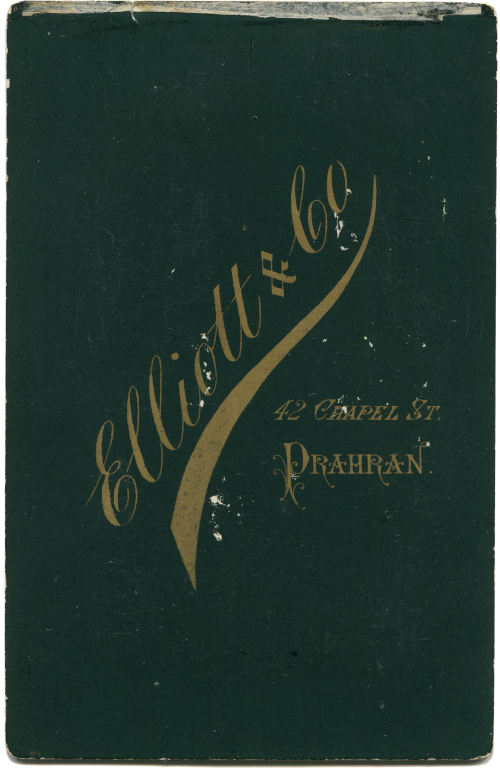
Shortly after her departure from The Federal Studio, Florence and her brother Wallace opened Elliott & Co., located at 42 Chapel Street in Prahran. It was a five-room property with a shopfront.
Chapel Street, like Bourke Street, was not short of photographers. Yeoman was a studio across the road from Elliott & Co., and nearby were Ezra W. Goulter and Burman. Fortunately, Florence’s knack for keeping sitters calm when they were about to have their photograph taken—an attribute highlighted by “Phota” back in 1879—meant that Elliott & Co. had a point of difference in relation to the other photographers in the area. The studio catered specifically for children and people of a nervous nature with the promise that they would not be let down.
Although there is no specific date for the closure of Elliott & Co., it appears Florence and Wallace decided to shut its door sometime during 1895, one year shy of a decade in business together. The studio was replaced by a clothing store, which opened in November of that year.
Separate ways and new lives
After the closure of Elliott & Co., Florence and Wallace went their separate ways and had begun new lives. Wallace returned to Tasmania where the Elliott family had originated. But he did not stay there for too long. He married in 1899 and took up life as a mining manager in Inverell in northern New South Wales, near the Queensland border. The mine, which was likely a diamond mine, was a family concern and the position was possibly given to Wallace as a wedding gift.
Florence, who had remained single throughout her working life, was by now in her late-30s and she, even before her brother, embarked on married life. She married William Hamilton Aitchison, an English widower with a teenage daughter. Aitchison was a civil engineer who had arrived in Australia in 1883. By 1901 Florence and William had moved to England where he continued his profession as a civil engineer. By 1911 Florence, at the age of 53, was an agent for the British Victoria Co.
Death
Florence Elizabeth Elliott remained in England for the rest of her life. She died on 11 March 1940 at the age of 82 from senility and debilitation. Her place of residence at the time of her death was a retirement home in Bristol, and her profession, as given on her death certificate, was housekeeper—a jump from her reputation as one of Melbourne’s finest female photographers.
ENDNOTES
[1] The Argus, “Public Notices: Important Announcements”, 14 February 1880. Elliot may have opened earlier but the first advertisement to be found indicates the date of February 1880.
[2] In these first advertisements Elliott always identified her studio as being opposite the Cole’s Book Arcade which was at 158 Bourke Street, Melbourne. Her studio was on the corner of Bourke Street and Brien Lane. Please note that the building which is there now was built some time later.
[3] The Herald, “Ladies’ Photography” 10 March 1880.
[4] Other women working in photography at this time in Melbourne included Lydia Burch Robinson at Tuttle & Co on Elizabeth Street, and Eliza Martin at Foster & Martin on Collins Street.
[5] The Herald, “Ladies’ Photography” 10 March 1880. According to “Phota” Miss Elliott was proficient in, and undertook all, the processes required: placement of sitter, lighting, and camera operation, developing and printing. This did separate Elliott from the other women working in Melbourne at the time as they did not appear to undertake all these tasks in their studios.
[6] Launceston Examiner, “River Cam”, September 13 1870.
[7] Launceston Examiner, “General News”, 2 March 1878. A report of the launching of the Elliott’s purpose built schooner, “Florence Elliott”.
[8] Bourke Ward rates, PROV, VPRS 5708/P9, Vol 18, 1879/2601 (digitised copy, viewed online 11 November 2018)
[9] The Herald, “Looking Backward: Pioneer of Gold Rush Days Recalls Early Melbourne”, 25 November 1916. George Elliott, Florence’s father, is interviewed about his early years in Australia.
[10] Launceston Examiner, “Editorial”, 7 August 1883
[11] The Sands Directory for 1879 records 20 photographers working in Melbourne’s city centre.
[12] “Fal-lals” is a fashion term meaning “fancy ornament especially in dress”. Merriam-Webster.com Dictionary, s.v. “fal-lal,” accessed July 30, 2020, https://www.merriam-webster.com/dictionary/fal-lal.
[13] The Herald, “Ladies’ Photography” 10 March 1880
[14] Gipps Ward Rates, PROV, VPRS 5708/P9, Vol 19, 1880/0061. (digitised copy, viewed online 3 November 2018). Chuck had paid the rates of £3/5s for 139 Bourke Street on 1 September 1880. This would carry Elliott through to April 1881 when the next rates were due.
[15] The Eastern Market was opened in late 1879 and was a mammoth shopping experience. Included were fresh food and livestock markets, fashion, furnishings, homewares etc., as well as restaurants, cafes and various other distractions. It was positioned on the corner of Bourke and Stephen Streets, the latter changing its name to Exhibition Street in 1880, and the Market extended back to Little Collins Street. Today the Southern Cross Tower occupies the same position. (https://www.historyvictoria.org.au/wp-content/uploads/2018/08/Melbournes-Streets-and-Lanes_Discovery-Series-No.-2.pdf )
[16] Dubbed by British journalist George Augustus Sala when in 1885 he witnessed first-hand Melbourne’s massive land and property boom.
[17] The Mayor’s Ball given by Melbourne’s Mayor was an annual event. It was a highlight on the calendar of Melbourne’s society and attendees would plan their ensemble months in advance. Having a photograph taken in their new gown was customary and copies would be sent to relatives. A selection of these would be printed in a contemporary journal or newspaper to show off the fashion, the work of the couturier and promote the wearer as a person of inimitable style.
[18] The Melbourne Deutscher Turn Verein was an organization devoted to the practice and promotion of German culture and sports. As part of their annual program a masked ball was held for adults and one for children. See also http://www.emelbourne.net.au/biogs/EM00936b.htm
[19] Punch, “The Originators of the Movement for Enfranchising the Women of Victoria”, 12 November 1908. Both Florence and Catherine Elliott signed the Monster Petition in 1891 but Catherine did not live to see women get the vote. She had suffered two years of heart trouble and finally succumbed to heart failure in early 1901, only a few weeks after the inauguration of Federation.